
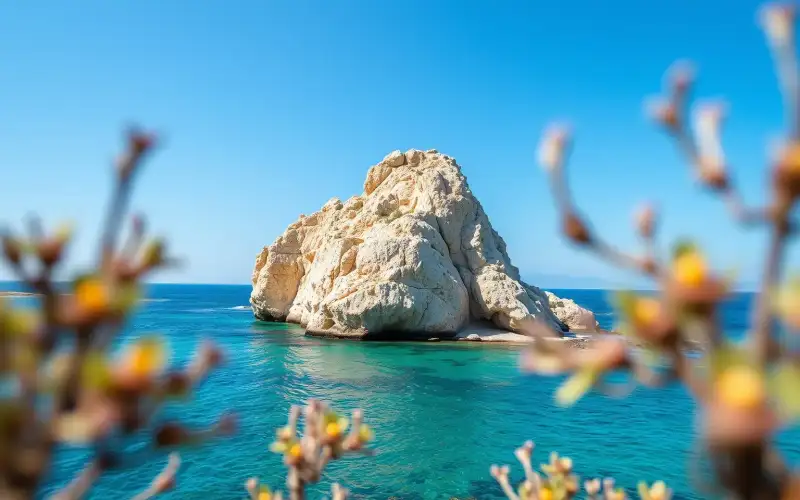
Last October, I watched a tour coach disgorge 47 passengers onto the car park at Petra tou Romiou at precisely 5:47 p.m. The golden hour was already underway. Within minutes, every decent vantage point along the coastal path had been claimed by people holding selfie sticks at shoulder height. The rock itself—that magnificent offshore limestone stack where Aphrodite allegedly emerged from the foam—had become almost invisible behind a forest of phones. This is the reality of visiting Cyprus's most famous landmark in 2026: without strategy, you'll spend more time queuing for position than actually experiencing the place.
Aphrodite's Rock, formally known as Petra tou Romiou, sits on the southwestern coast roughly 25 kilometres east of Paphos town centre. The A6 highway runs directly past it, making it deceptively convenient. That convenience is precisely the problem. Unlike the Akamas Peninsula or the Troodos Mountains, this isn't a place you can escape the crowds simply by showing up. You need intelligence, timing, and a willingness to abandon conventional wisdom about when tourists visit.
The Numbers Behind the Legend
Cyprus Tourism Organisation figures suggest approximately 540,000 people visit Petra tou Romiou annually. That sounds manageable until you realise 380,000 of those visits cluster between April and October, with June through September accounting for over 200,000 arrivals. The busiest single period runs from 5:00 p.m. to 7:00 p.m. during summer months, when sunset-seeking photographers converge like migrating birds. Tour operators have essentially industrialised the golden hour here, stacking departures from Paphos hotels between 4:30 and 5:15 p.m. to catch the light.
The car park capacity is approximately 180 vehicles. During peak season on a clear evening, you'll find it at full capacity by 5:30 p.m., with overflow parking extending 200 metres along the roadside. Local residents report that traffic on the A6 becomes visibly congested by 5:45 p.m. on summer Fridays and Saturdays. The cafés immediately adjacent to the site—there are three small establishments selling standard Greek coffee and bottled water—routinely sell out of cold drinks by 6:15 p.m.
When to Actually Visit: The Timing Strategy
The counterintuitive truth is that Aphrodite's Rock is most rewarding when the light is poorest. A visit in late morning—say, 10:30 a.m. to noon—yields an almost empty foreshore. The sun is high and unflattering for photography, which is precisely why tour operators avoid this window. You'll find perhaps 30 to 40 people scattered across the entire viewpoint, mostly independent travellers and a few committed photographers bracketing exposures for HDR work.
February through April offers the best balance of decent light and manageable crowds. The sun sets at approximately 6:30 p.m. in mid-April, allowing you to arrive at 5:00 p.m. and photograph in near-solitude for 45 minutes before the tour buses begin arriving. March particularly rewards early planning: the equinox brings sunset at 6:15 p.m., temperatures hover around 18–22°C (comfortable for standing outdoors), and Easter holiday crowds haven't yet mobilised. The rock faces west-northwest, so the setting sun creates extraordinary colour directly behind it without the harsh glare that summer produces.
September through November provides another overlooked window. The summer tour season collapses rapidly after 15 September. By early October, sunset times have shifted to 6:45 p.m., and the car park clears noticeably by 6:30 p.m. as operators rush to return clients to Paphos for dinner reservations. October offers warm days (25–28°C), manageable light, and—crucially—the crowds have thinned by 60 to 70 percent compared to July.
Conversely, avoid June, July, and August entirely unless you're prepared for genuine chaos. Sunset occurs at approximately 8:15 p.m. during July peak, meaning the main tourist rush extends from 6:30 p.m. onwards. The foreshore becomes actively dangerous during these months—I've documented near-collisions between photographers backing up for wide shots and couples navigating the rocky terrain.
The Geography of Good Vantage Points
The site comprises roughly 500 metres of accessible coastline, though only about 150 metres provides genuinely useful photography angles. The car park sits elevated approximately 40 metres above sea level. Most visitors simply descend the nearest path and cluster on the central viewing platform, which offers a direct but unimaginative view of the rock. This is where the bus groups congregate, creating a visual bottleneck.
The superior position lies 80 metres south along the coastal path (bearing roughly 160 degrees magnetic from the car park entrance). Here, a secondary rocky outcrop provides elevation and angles the rock against the setting sun rather than viewing it head-on. This position requires perhaps five minutes' walk from the main car park, which is enough to deter 70 percent of casual visitors. The path is straightforward limestone, well-defined, and entirely safe in daylight. Few people navigate this far.
For wide-angle compositions encompassing both the rock and the surrounding coastline, the northern approach—roughly 120 metres north—works well. You'll find a smaller parking area (capacity approximately 25 vehicles) and fewer people. This angle captures the dramatic cliff formations either side of the rock and is particularly rewarding during late afternoon when the limestone takes on golden and russet tones.
The eastern approach, accessible via a rough track near the southernmost café, provides the most intimate framing but requires scrambling over limestone and is genuinely hazardous during windy conditions. I'd recommend this only for photographers with rock experience and proper footwear.
Technical Photography Guidance
Aphrodite's Rock presents specific technical challenges. The water surrounding the rock is exceptionally reflective, which confuses even sophisticated metering systems. Most mirrorless and DSLR cameras will underexpose the rock itself when the sea occupies 40 percent or more of the frame. Shoot in manual mode or use exposure compensation of +0.7 to +1.3 stops. Bracket your exposures in three-stop intervals if you're planning post-processing blending.
The rock's silhouette against the sunset creates extraordinary contrast. A polarising filter reduces glare from the water surface and deepens sky saturation by approximately 1.5 stops. Given the consistent westerly wind at this location, bring a lens hood—salt spray is a genuine hazard even during calm conditions.
Colour temperature shifts dramatically here. The limestone begins the day at roughly 4500K (neutral), warms to 5500K by midday, and drops to 2200K or lower during final 20 minutes of sunset. Rather than chasing perfect colour temperature, shoot in RAW format and adjust in post-processing. The rock's natural colour variation—cream, pale orange, and occasional pink undertones—is more important than absolute colour accuracy.
Wind is relentless. Even on supposedly calm days, sustained gusts of 15–20 knots are common. If you're using anything longer than a 200mm focal length, bring a tripod. Handheld shooting at sunset light levels requires ISO 3200 minimum, which introduces visible noise on most sensors. A tripod allows you to use ISO 400–800 and longer shutter speeds, yielding cleaner files.
Understanding the Legend: Why People Come
The mythology surrounding Aphrodite's Rock draws as many visitors as the landscape itself. According to Hesiod's Theogony, Aphrodite emerged fully formed from sea foam near this location following Uranus's castration. She drifted ashore on a scallop shell, already divine and beautiful. The ancient Greeks believed that swimming in the waters here granted beauty and eternal youth—a claim that, unsurprisingly, attracted considerable interest.
The rock itself is approximately 105 metres in length and rises roughly 30 metres above sea level. Its official designation as a UNESCO World Heritage Site (part of the Paphos archaeological park) reflects its cultural significance rather than geological rarity. The geological formation is Maastrichtian limestone, roughly 65 million years old, created during the late Cretaceous period when this region was entirely submerged.
Local tradition holds that swimming the distance between the shore and the rock grants perpetual beauty. This claim lacks any historical documentation but has become sufficiently embedded in tourist expectation that the site management has established clear warnings against the practice. The waters are genuinely dangerous: currents exceed 0.5 knots even during calm conditions, and the rock's offshore position creates unpredictable wave patterns. I've never observed anyone actually attempt the swim, though the myth persists.
The Turkish name for the location, Afrodit Kayalığı, and the Greek variant Petra tou Romiou both reference the same legend.

Comments (4 comments)