
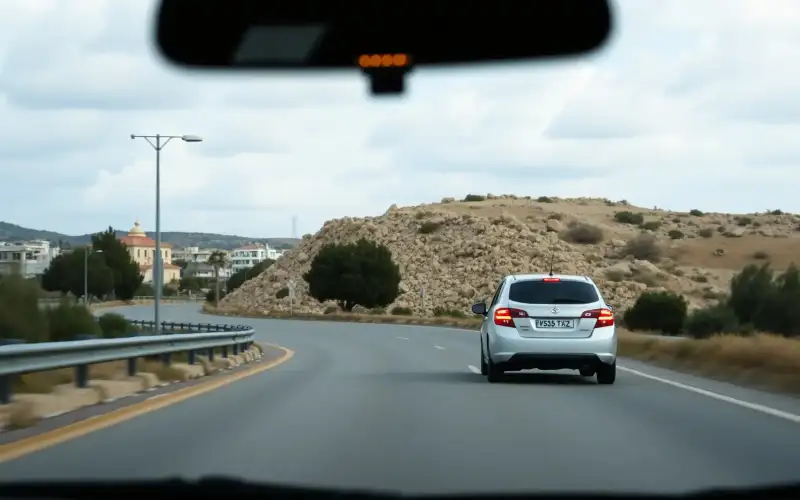
I watched a British couple pull up to a petrol station in Paphos last summer, reverse smoothly into a space on the left side of the pump, then sit there for three minutes trying to figure out why they couldn't reach the fuel door. The pump was on the right. That's when I realised how many visitors arrive thinking left-hand driving in Cyprus is just a mirror image of home—it isn't. The roads are narrower, the drivers are faster, and the rules are written in a language that doesn't always translate the way you'd expect.
After fifteen years guiding visitors through the Lake District and Akamas trails, I've spent enough time on Cypriot roads to know exactly where British drivers go wrong. The good news: once you understand the local rhythm and a few practical adjustments, you'll drive here more safely than most locals.
Understanding Cyprus Road Rules: The Basics That Matter
Cyprus uses left-hand traffic, same as the UK, but the similarity ends there. Speed limits are posted in kilometres per hour, not miles, and they're enforced more strictly than many visitors expect. In urban areas, you're looking at 50 km/h (31 mph). On open roads, it jumps to 100 km/h (62 mph). Motorways—the A3 and A6 that connect Paphos, Limassol, and Nicosia—allow 120 km/h (75 mph), but traffic cameras are relentless.
The biggest shock for British drivers is that seatbelts are legally mandatory for all passengers, and children under 12 must sit in appropriate car seats. Fines for non-compliance start at €85 and climb quickly. I've seen rental companies charge €200 if you return a car without proper child seats installed.
One rule that catches people off guard: you cannot use your mobile phone while driving, even hands-free in some interpretations. The police take this seriously. Headlights must be on during the day in winter months, and carrying two warning triangles, a reflective jacket, and a fire extinguisher is compulsory. Most rental firms include these, but check your paperwork.
Parking in Paphos town centre requires understanding the colour-coded kerb system. Blue lines mean paid parking (usually €0.50–€1 per hour). White lines are free but time-limited. Yellow lines mean no parking. Red lines mean absolutely no parking, ever. I've seen cars towed from red zones within minutes of the warden passing.
The Left-Hand Drive Adjustment: More Than Just Switching Sides
Renting a left-hand drive car in Cyprus feels natural for British visitors until you hit the first roundabout. The instinct to hug the left side of your lane will fight you for the first hour. Here's what actually happens: you're driving on the left side of the road, but the car's steering wheel is on the left side of the vehicle. This means your sightlines change completely.
Overtaking becomes the first real test. In the UK, you move to the right lane to pass. In Cyprus, you move to the left. Your view of oncoming traffic is clearer because you're sitting on the left side of the car, but your brain hasn't rewired yet. The golden rule: don't overtake unless you can see at least 200 metres of clear road ahead. Cypriot drivers are impatient, and they'll flash their headlights aggressively if you're slow.
At roundabouts, traffic moves clockwise (same as the UK), but the geometry feels different. You're entering from the right side of the road and exiting to the left. Some roundabouts in Paphos are surprisingly tight, especially the one near the Harbour. Take it slowly your first time. There's no shame in circulating twice to find your exit.
Reversing and parking are where the adjustment really matters. Your rear-view mirror coverage is different. The car's length feels offset because you're sitting on the opposite side from what you're used to. In tight Kato Paphos streets, where spaces are barely wider than the car itself, use the wing mirrors constantly. Many rental cars have small blind spots on the left side that catch people out.
One practical tip from years of navigating narrow mountain roads: if you're nervous, spend your first 30 minutes on quiet roads around your accommodation. Drive to a supermarket car park, practise parking, then tackle busier routes. The adjustment takes about two hours of focused driving, not two days.
Navigating Paphos Town: The Real Challenge
Paphos town centre isn't designed for modern traffic. Medieval street layouts meet 21st-century car volumes, and the result is chaotic. The main arteries—Evagoras Avenue, Gladstone Street, and the roads around the Harbour—are one-way systems that confuse even regular visitors. GPS helps, but the town's narrow streets mean you're often too close to parked cars and pedestrians to feel comfortable.
The harbour area, Kato Paphos, is the worst. Streets are barely two cars wide, parking is a blood sport, and delivery trucks seem to arrive during peak tourist hours. If you're staying in Kato Paphos, I'd recommend parking once and using taxis or walking. The cobbled streets and narrow passages are beautiful to explore on foot but a nightmare to navigate by car.
Driving uphill through the old town requires confidence. The streets are steep, winding, and often one-way. If you meet another car, one of you has to reverse—and reversing uphill on a narrow Cypriot street is not something you want to attempt on your second day of left-hand driving. Local drivers handle this with practiced ease, honking their horns to announce their presence. It's chaotic but it works.
The road to Coral Bay and Latchi, north of Paphos, is modern and straightforward. It's an excellent route for building confidence. The coastal views are spectacular, and traffic is lighter than in town. From Paphos Harbour, it's about 15 km north, taking roughly 20 minutes in normal traffic.
Mountain Driving to Troodos: Where Confidence Meets Caution
The Troodos Mountains rise to 1,952 metres and offer some of Cyprus's most dramatic scenery. The main route from Paphos is the B9 road, which climbs steeply and winds through pine forests. It's a spectacular drive, but it demands respect.
The road surface is generally good, but it's narrow and the gradient is relentless. Hairpin turns appear frequently, and the drop-offs are real. Local drivers take these curves at speeds that seem insane until you realise they know every bend. Your rental car's brakes will work fine, but don't ride them continuously—use lower gears to control speed on long descents. Overheated brakes are a genuine risk on mountain roads.
The journey from Paphos town to Troodos village takes about 90 minutes. The first 30 km climb steadily but aren't too challenging. After that, the road gets serious. There are several viewpoints where you can pull over safely—use them. Your passengers will appreciate the break, and you'll get a sense of how much altitude you've gained.
Weather changes rapidly in the mountains. In winter (December to February), snow is possible above 1,200 metres. Summer temperatures can exceed 35°C in the lowlands but drop to 20°C in Troodos. Visibility can shift from clear to misty in minutes. Always carry water and check weather forecasts before heading up.
The descent is harder than the climb. Your brakes will work overtime, and fatigue sets in faster than you'd expect. If you're driving down in late afternoon, the sun will be low and in your eyes. Wear sunglasses and take it slowly. There's no prize for speed on mountain roads.
Local Driving Habits: What You Need to Know
Cypriot drivers are aggressive by British standards. They tailgate, flash headlights to demand overtaking space, and treat speed limits as suggestions. This isn't personal—it's just the driving culture. Getting offended or trying to enforce UK-style road courtesy will only escalate tension.
Indicators are used sparingly. Many drivers don't signal lane changes or turns until the last moment. Assume every car around you might suddenly change direction. This is especially true in town traffic and at roundabouts.
Horns are used constantly and not always as a warning. A horn might mean


Comments (4 comments)