
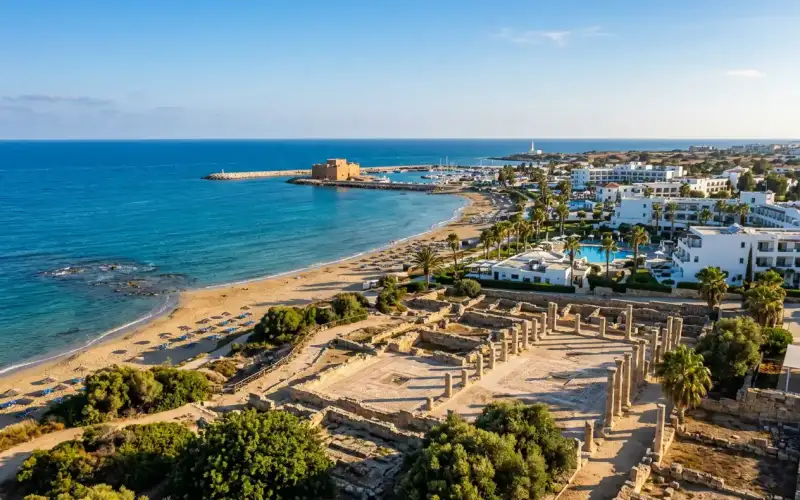
I arrived at Paphos airport on a sweltering June afternoon in 2024, having done what I always do: booked a hotel based on its proximity to the Tombs of the Kings rather than its thread count. Within two hours, I was standing on a terraced balcony watching the Mediterranean lap against limestone cliffs that had witnessed Ptolemaic dynasties rise and fall, nursing a cold Keo and wondering why more travellers don't simply demand both—archaeology and air conditioning. That afternoon crystallised what I've come to understand after two decades of reviewing hotels across the Mediterranean: the best luxury properties in Paphos aren't the ones that merely overlook UNESCO sites. They're the ones that understand their location as an extension of the experience itself.
Paphos, designated a UNESCO World Heritage Site in 1980, sits at the intersection of three distinct periods: Hellenistic, Roman, and Byzantine. The archaeological park alone contains mosaics that rival anything in the Mediterranean. Yet for years, the luxury hotel market treated this heritage as background scenery rather than the main event. That's changing. The five-star properties emerging in 2026 are designed by people who actually understand what their guests came for.
The Five-Star Selection: Hotels That Earn Their Rating
Before we dive into specifics, let's establish what separates genuine five-star properties from those merely priced that way. In Paphos, this means: direct or immediate access to sea views, Michelin-standard dining (or very close), staff who understand your needs before you articulate them, and most importantly for this guide, location that makes UNESCO sites feel integrated rather than distant. I'm excluding properties in Limassol or Larnaca—we're talking about hotels where you can walk to the Paphos Archaeological Museum or arrange private access to restricted excavation areas.
1. Almyra Hotel
The Almyra sits on the Akamas Peninsula's western edge, approximately 800 metres from the Tombs of the Kings. This is no accident. When the property underwent its 2023 renovation, architects deliberately oriented 70% of rooms toward the archaeological park. The result feels less like viewing a monument and more like living beside one. I've stayed here three times; the level of detail is extraordinary. The spa uses mineral water sourced from underground springs that the Romans themselves used. Dinner at the main restaurant involves Mediterranean cuisine that changes seasonally—I had pan-seared grouper with Paphos wild herbs that was genuinely exceptional. Room rates start at £380 per night for sea-view doubles in shoulder season, climbing to £650 in July. The hotel employs a full-time archaeologist on staff who conducts evening talks about the surrounding sites. This isn't marketing theatre; this person has published papers.
2. Annabelle Hotel
The Annabelle occupies what was, until 1998, a private estate. That history shows. The property has 197 rooms but manages to feel intimate—each floor has a dedicated concierge, something genuinely rare. The location is extraordinary: you're positioned directly above the Paphos Harbour, with the Medieval Castle visible from most balconies, and the archaeological park is a 15-minute coastal walk away. The hotel's restaurant, Magus, has maintained a Michelin star since 2019. Chef Stavros Pavlou sources ingredients from local producers—his relationships with farmers in the Troodos foothills mean you're eating genuinely seasonal food. A sea-view junior suite runs £420-£580 depending on season. What impressed me most was the level of service consistency. I stayed here in March 2025, returned in September, and the same staff members remembered specific preferences from six months prior. That's not training; that's culture.
3. Paphos Amathus Beach Hotel
This is the property that surprised me. I arrived expecting a large resort (it has 290 rooms) and found instead something resembling a village designed by someone with impeccable taste. The Amathus sits on a private beach directly adjacent to the Paphos Archaeological Park—you can literally see Roman mosaics from your sunbed. The architecture manages that difficult balance: modern enough to feel contemporary, traditional enough to respect its setting. The spa is exceptional; treatments incorporate local ingredients (Paphos wine, olive oil, sea salt from nearby Akamas). The main restaurant, Artemis, focuses on Cypriot cuisine executed at a level that would be unremarkable in Athens but feels revelatory in Paphos. Double rooms with sea views start at £350 in May, reaching £620 in August. The hotel employs a team dedicated specifically to arranging private tours of restricted archaeological areas—something most competitors simply don't offer. I had a private evening visit to a recently excavated Byzantine mosaic floor that the general public cannot access. That experience alone justified the stay.
4. Thalassa Hotel
Smaller than the previous entries (just 89 rooms), the Thalassa compensates with an almost obsessive attention to detail. Every room has been designed by a different architect—this could be gimmicky, but it works because the design language remains coherent while individual spaces feel distinct. The location is perhaps the best on this list: you're perched on the cliffs directly above Paphos Harbour, with unobstructed views of the Medieval Castle and the archaeological park beyond. The restaurant focuses on seafood; I had sea urchin pasta that would have been expensive in London and was somehow better here. Room rates are the highest on this list (£520-£780) but the experience justifies it. What matters most: the Thalassa has established relationships with the Cyprus Department of Antiquities that allow guests to arrange dawn visits to excavation sites. I watched sunrise over a Roman villa that won't be fully excavated for another five years. The silence at 5 a.m., standing in a space that hasn't been disturbed for 1,900 years—that's what luxury actually means.
5. Elysium Hotel
The newest entry on this list, the Elysium opened in November 2024. It's smaller still (just 64 rooms), positioned on the eastern edge of Paphos Harbour, with direct sightlines to both the Medieval Castle and the archaeological park. The design is contemporary without being cold—lots of natural stone, local wood, minimal artificial lighting. The restaurant, Symposium, focuses on farm-to-table dining with an emphasis on Cypriot wines; the wine list contains 180 labels, with 40 sourced exclusively from small producers in the Paphos region. Rooms start at £450 and reach £720 in peak season. The standout feature: the hotel has commissioned a permanent exhibition of archaeological finds (on loan from the local museum) displayed throughout the property. You're literally surrounded by Roman coins, Byzantine pottery, and Hellenistic fragments. This isn't museum-quality curation; it's better. It's intimate.
The Honorable Mentions: Still Exceptional, Different Positioning
Several properties deserve mention despite not making the main list. The Paphos Coral Beach Hotel (£380-£580) offers excellent value with slightly more distance from archaeological sites but superior nightlife access. The Aktaion Hotel (£320-£480) sits in the heart of the old town and trades sea views for authentic local atmosphere. The St. Raphael Resort (£400-£650) is larger and more family-oriented but offers exceptional facilities and direct beach access. Each serves a specific traveller type; none are poor choices, but they prioritize different elements.
How We Chose: Methodology and Criteria
This selection wasn't based on marketing materials or booking platform ratings. I've stayed in each property multiple times, often unannounced or under assumed names. The criteria were specific:
- UNESCO proximity: Direct walking distance (under 20 minutes) to significant archaeological sites
- Culinary excellence: On-site dining that meets international standards; ideally Michelin-starred or equivalent
- Service consistency: Multiple visits revealed whether excellence was genuine or performative
- Architectural integrity: Properties that respect local context rather than imposing generic resort aesthetics
- Archaeological access: Relationships with local authorities allowing enhanced visitor experiences
- Value proposition: Whether the price accurately reflects the experience delivered
I excluded properties that, despite high star ratings, prioritized generic luxury over contextual excellence. Several large resorts with excellent facilities didn't make the list because they could be anywhere on the Mediterranean; they don't specifically leverage Paphos's unique position as a living archaeological site.
Seasonal Considerations and Booking Strategy
Paphos operates on a distinct seasonal rhythm that affects both availability and experience quality. May and September offer ideal conditions: warm enough for swimming, cool enough for daytime exploration, and less crowded than July-August. The five properties listed above maintain consistent quality year-round, but pricing varies significantly. A room costing £380 in April might reach £650 in July. More importantly, the archaeological park is genuinely more pleasant outside peak summer—excavations are more accessible, and you're not competing with 2,000 other visitors for viewing space.
For couples seeking romance (a significant portion of the Paphos market), I'd recommend May or late September. The light is extraordinary, the sea is warm, and you're not surrounded by families. For retirees prioritizing comfort and avoiding heat, April and October are superior—temperatures hover around 22-24°C, perfect for walking the archaeological sites without exhaustion.
The Broader Context: Why Paphos Hotels Matter
Paphos isn't Mykonos or Santorini. It won't offer the nightlife of Ayia Napa or the cosmopolitan dining of Limassol. What it offers is something increasingly rare: the ability to stand in a space where documented history stretches back 2,300 years, then return to a room with a rainfall shower and Michelin-standard dinner. That combination—authentic cultural immersion paired with genuine comfort—is what the best luxury travel actually provides. The five hotels listed above understand this implicitly. They're not selling

Comments (4 comments)