
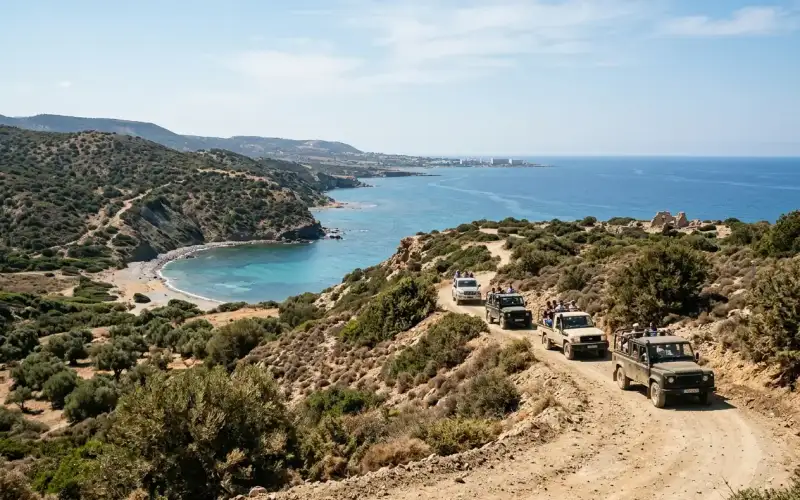
A client of mine—a retired property developer from Surrey—once described his Akamas jeep safari as 'controlled chaos with a geological lecture thrown in.' That's not far off. The Akamas Peninsula, jutting defiantly into the Mediterranean north of Paphos, remains one of Europe's most intact wilderness zones, and the only way most visitors experience its 230 square kilometres of scrubland, hidden coves, and Byzantine ruins is via a high-clearance vehicle piloted by someone who actually knows where the track ends and the ravine begins.
By 2026, the jeep safari industry around Paphos has matured considerably. What was once a Wild West operation—tourists bouncing around in modified Land Rovers with minimal safety briefings—has evolved into a regulated, increasingly professional sector. Yet the adventure itself hasn't been sanitised. The terrain is still punishing. The dust still gets everywhere. And the silence, once you stop the engine and step out into a carob forest, is genuinely unsettling after hours of mechanical roar.
This guide covers everything you need to know before booking: the three main route types, which operators are worth your money, what the terrain actually demands of your body, and the unglamorous practicalities of spending six hours in a bouncing metal box.
The Akamas Landscape: Why Jeeps Are Mandatory
The Akamas isn't accessible by conventional road. There are perhaps two kilometres of proper tarmac on the peninsula itself, mostly leading to the small settlement of Neo Chorio. Everything else—the archaeological sites, the viewpoints, the beaches accessible only by foot or vehicle—requires clearance of at least 300mm and a driver unafraid of steep descents into dried river beds.
The terrain breaks down into three distinct zones. The southern reaches, approaching from Paphos, consist of relatively stable limestone tracks with moderate gradients—suitable for less robust vehicles but still requiring concentration. The central plateau, around 400 metres elevation, features harder-packed earth and stone, with occasional washouts after winter rains. The northern approaches toward Akamas Point involve genuine off-road navigation: boulder-strewn paths, hairpin descents, and sections where the track seems to exist only in the driver's memory.
Vegetation is sparse—carob, wild olive, and aromatic scrub—which means zero shade during summer months. Temperatures regularly exceed 38°C in July and August. Winter (November to March) brings occasional rain that can render certain routes temporarily impassable, though operators maintain multiple alternatives. Spring (April-May) is optimal: warm but not scorching, wildflowers in bloom, and roads in good condition.
The peninsula has been designated a Natura 2000 protected area since 1999, which restricts development but doesn't prevent tourism. Most jeep routes follow established tracks that predate modern conservation laws, creating a somewhat awkward coexistence between environmental protection and visitor access.
The Three Primary Route Options
Most operators offer variations on three core itineraries, each with distinct characteristics and appeal.
Route One: The Coastal Loop (5-6 hours, moderate difficulty)
This is the entry-level safari, popular with families and visitors over 65. It covers roughly 40 kilometres, departing Paphos (usually around 08:30) and heading north through cultivated valleys before reaching the Akamas plateau. The first major stop is typically Lara Beach, a protected nesting site for loggerhead and green turtles where visitors disembark for a 15-minute walk to the shoreline. The beach itself is striking—completely undeveloped, backed by low cliffs, and genuinely wild.
From Lara, the route swings east along the northern coast, stopping at several viewpoints overlooking Chrysochou Bay and the Turkish Kyrenia Mountains across the water. One memorable vista point sits roughly 300 metres above sea level, with unobstructed views extending 40 kilometres on clear days. Lunch is typically taken at Neo Chorio, a village of perhaps 40 permanent residents where operators have arrangements with one of two tavernas for basic grilled fish or souvlaki (usually €12-16 per person, not included in tour price).
The return leg descends through Tilliria, a region of scattered olive groves and abandoned stone cottages, before rejoining the main Paphos road by late afternoon. Total elevation gain is roughly 400 metres, and the vehicle spends perhaps 60% of time on recognisable tracks.
Route Two: The Interior Plateau (6-7 hours, challenging)
This option ventures into the genuine wilderness. Departing around 08:00, the jeep climbs steeply inland, ascending to the central plateau via a series of switchbacks that require active concentration from passengers—holding on is not optional. The destination is the Akamas Point area, where Byzantine ruins and panoramic viewpoints justify the discomfort.
Two specific stops distinguish this route. First, the ruins of Ayios Ioannis, a 6th-century monastery perched on a ridge with views extending to the Paphos coast. The site is modest—mostly foundations and scattered column drums—but the setting is extraordinary. Second, a natural spring near Kato Akamas village, where the jeep stops for a 20-minute break. The water is potable and refreshingly cool, a genuine relief in summer heat.
The final approach to Akamas Point itself is the most technically demanding section: a descent of perhaps 200 metres over roughly two kilometres, with hairpin turns and loose surfaces. Operators typically spend 30-40 minutes at the point itself, allowing passengers to walk to the lighthouse structure (non-functional since 2001) and absorb the view of the Mediterranean sprawling below.
This route is genuinely tiring. Passengers report muscle soreness the following day, particularly in the lower back and legs. It's not recommended for anyone with mobility issues or recent joint surgery. Total elevation change is approximately 600 metres.
Route Three: The Extended Wilderness (7-8 hours, advanced)
Offered only by a handful of operators, this combines elements of Routes One and Two while adding remote archaeological sites and longer stretches of genuine off-road driving. It's marketed toward experienced adventurers and typically includes a full-day packed lunch (rather than a taverna stop), longer vehicle downtime at multiple viewpoints, and visits to sites rarely seen by casual tourists.
Specific stops vary by operator and season, but commonly include the ruins of Ayios Konon, a Venetian-era fortification overlooking the western coast, and the Fontana Amorosa spring, a natural pool fed by underground water. The route demands physical fitness—several stops involve 20-30 minute walks on uneven terrain—and a high tolerance for discomfort. Vehicle time on genuinely difficult terrain (boulder fields, steep descents, narrow gorges) can exceed 4 hours.
This option is priced accordingly: typically €95-130 per person versus €55-75 for the coastal loop.
Reputable Operators: 2026 Assessment
The Paphos jeep safari market includes roughly 15-20 operators of varying quality. Several are essentially one-man operations; others are integrated into larger tourism companies. Based on 2026 reputation, safety records, and passenger feedback, the following merit serious consideration.
Akamas Experience
Established 2009, family-run, based in Paphos town. Fleet of eight Toyota Land Cruisers and Nissan Patrols, all regularly serviced. Drivers are long-term employees (average tenure 8+ years), speak fluent English, and have genuine knowledge of archaeology and local ecology. Routes are well-structured, with clear safety briefings and emergency protocols. Pricing: €65-110 per person depending on route. Booking via their office on Ayios Antoniou Street, Paphos, or online. They offer a 10% discount for bookings made more than 14 days in advance.
Cyprus Off-Road Adventures
Larger operation, partnered with several hotels. Fleet includes newer vehicles with air-conditioning (a genuine comfort feature on summer routes). Guides vary in quality—some are excellent, others are primarily drivers. The extended wilderness route is their specialty, with trained naturalists leading walks at archaeological sites. Pricing: €70-125 per person. They offer hotel pickup/drop-off for an additional €10 per person, which is convenient for visitors staying in Coral Bay or Paphos town.
Akamas Safari Tours
Smaller operator, five vehicles, owner-managed. Known for flexibility—they'll customize routes based on passenger interests and fitness levels. Less structured than competitors, which appeals to some travellers but concerns others. Pricing is competitive (€55-100 per person), and they offer discounts for groups of six or more. Safety record is clean, but their vehicles are slightly older (average age 7-8 years).
Avoid operators offering prices below €45 per person—these typically cut corners on vehicle maintenance and driver training. Several discount operators have been cited by local authorities for unsafe driving practices.
What Your Body Will Experience
Jeep safaris are not leisurely outings. Expect continuous vibration, significant noise (conversation becomes difficult above 30 kilometres per hour), and physical jolting, particularly on the interior plateau routes. Passengers report lower back strain, neck stiffness, and general fatigue. The experience is not painful for most people, but it's far from comfortable.
Dust infiltration is inevitable. Despite closed windows, fine limestone dust penetrates vehicles, coating skin, hair, and clothing. Bring a damp cloth or wet wipes for your face. Sunburn is a serious risk—the sun reflects intensely off pale limestone, and wind speed creates a false sense of coolness. SPF 50+ sunscreen is essential, reapplied every 90 minutes.
Dehydration is the primary health concern. Most operators provide bottled water, but bringing additional fluids is sensible. Avoid alcohol the night before; hangovers and eight hours of vehicle jolting create a miserable combination. Wear supportive footwear (trainers or hiking boots, not sandals) for the walking portions—terrain is rocky and uneven.
Practical Preparation and Attire
Dress in lightweight, long-sleeved clothing. This sounds counterintuitive in Mediterranean heat, but it prevents sunburn and provides protection from thorny vegetation during walking stops. Neutral colours (khaki, light grey) are preferable to bright whites, which intensify glare and heat absorption. Avoid cotton; quick-dry synthetic fabrics are superior in dusty conditions.
A wide-brimmed hat is essential, not optional. Baseball caps offer insufficient coverage. Bring sunglasses with UV protection—the glare from limestone is genuinely damaging to unprotected eyes. A light scarf or buff can be wrapped around the nose and mouth during particularly dusty sections, though most operators drive at speeds that minimize this issue.
Footwear deserves serious consideration. The terrain includes loose rocks, hidden holes, and occasional cacti. Hiking boots or sturdy trainers with ankle support are strongly recommended. Flip-flops have caused numerous twisted ankles; they're a poor choice. Pack a small rucksack (15-20 litres) rather than a shoulder bag—both hands free are preferable when navigating steep terrain.
Bring a camera with a dust-resistant body if you own one. Phone cameras are adequate, but dust can damage sensors. Consider a protective case or bag for electronics. Waterproof bags are unnecessary unless visiting during winter months when occasional rain is possible.
Booking, Costs, and Logistics
Most operators accept bookings via online platforms (GetYourGuide, Viator, Klook) or direct contact. Direct booking is often cheaper (5-10% savings) and allows negotiation on pickup times and route customization. Cancellation policies typically allow full refunds up to 48 hours before departure; cancellations within 48 hours forfeit 50% of the fee.
Pricing in 2026 ranges from €55-130 per person, with the following rough breakdown: coastal loop €55-75, interior plateau €70-95, extended wilderness €95-130. These prices typically include vehicle, driver, and basic water. Lunch is rarely included; budget €12-18 for a taverna meal or €8-12 if bringing packed provisions.
Pickup is typically from your accommodation or a central Paphos location (Karavelle Hotel area, Paphos Harbour) around 08:00-08:30. Return is usually 14:30-15:30 for shorter routes, 16:00-17:00 for extended options. Allow extra time if your accommodation is outside central Paphos; some operators charge supplements for pickups beyond their standard zone.
Group discounts are common. Booking for six or more passengers typically yields 10-15% reductions. Family packages (two adults plus two children under 12) are offered by several operators at modest discounts (5-8%).
Seasonal Considerations and Booking Windows
Summer (June-August) is peak season. Temperatures exceed 35°C regularly, and operators run multiple daily departures. Booking 2-3 weeks in advance is advisable. Winter (November-February) sees fewer departures and occasional route closures after heavy rain, but conditions are genuinely pleasant for active travellers. Spring (April-May) and autumn (September-October) offer ideal balance: warm, dry conditions and smaller group sizes.
August is the worst month for comfort—heat, dust, and crowded vehicles create miserable conditions. If you're flexible, avoid it entirely. May and October are optimal for physical comfort and experience quality.
First-time visitors should book with established operators (Akamas Experience or Cyprus Off-Road Adventures) rather than gambling on smaller outfits. The €10-20 price premium is worthwhile for professional service and genuine safety standards.
Comments (4 comments)