
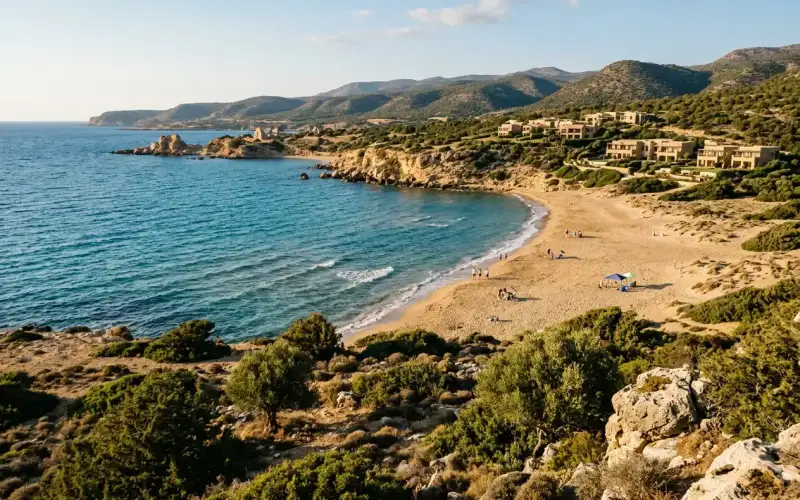
Last April, I watched a seven-year-old from Surrey spot her first loggerhead turtle gliding past the shallows at Lara Beach. Her mother's face said everything—this wasn't another generic resort holiday. This was the moment they'd come for. Lara Beach, tucked into Paphos's northwestern corner, has quietly become the destination British families return to year after year, often without telling their friends. The beach stretches nearly three kilometres of pale sand, backed by low cliffs and wildflowers, with virtually no commercial development. No jet skis. No beach bars blasting dance music. Just families, turtles, and the kind of silence that makes you remember why you left London.
For 2026, Lara Beach sits at a crossroads. Tourism infrastructure is improving, but the soul of the place remains untouched. That balance won't last forever, which is exactly why now is the time to experience it properly. This guide covers where to stay, what to do with children aged 3 to 16, and the practical details that transform a nice beach holiday into the kind of trip your family talks about for years.
Overview: Why Lara Beach Works for Families
Lara Beach occupies a peculiar niche on the Cyprus map. It's not a resort—there are no all-inclusive hotels or swim-up bars. It's a working fishing village with a protected beach, home to one of the Mediterranean's most important sea turtle nesting grounds. The nearest supermarket is 8 kilometres away in Paphos town. Mobile signal can be patchy. And yet, families keep coming back.
The appeal is straightforward: safety, space, and authenticity. The beach has a lifeguard station (summer months), and the shallow gradient means even nervous swimmers feel confident within metres of the shore. Children can run between the water and the tavernas without crossing roads. Parents can actually relax. The village itself—perhaps 200 permanent residents—operates at a pace that suits families with young children. Dinner at 7pm feels early; 8:30pm is standard. Closing time is whenever the last customers leave.
The turtle-nesting season (May to August) adds educational weight to the holiday. The Lara-Toxeftra area is protected by law, with restricted access to certain sections. This isn't a gimmick—it's genuine conservation. Seeing hatchlings emerge at dusk, or spotting an adult turtle in the shallows, creates the kind of memory that sticks. Many families time their 2026 visits around June or July specifically for this.
Accessibility is improving. The road from Paphos (via Akamas Peninsula) is now fully paved, taking about 45 minutes by car. There's a small car park with basic facilities. Water and ice are available at the beach tavernas. Shade is limited to taverna umbrellas and the occasional tamarisk tree, so bring beach tents. The beach is dog-friendly (outside nesting season), which appeals to families with pets.
For British visitors aged 40–70, particularly retirees and couples with older children, Lara offers something increasingly rare: a Mediterranean beach that feels genuinely Mediterranean, not theme-parked. It's less polished than Coral Bay, less crowded than Lara Lofou, and infinitely more character-filled than anything near Paphos town centre.
Accommodation: Where to Stay Near Lara Beach
Here's the reality: there are no hotels at Lara Beach itself. The nearest options are in nearby villages—Akamas, Droushia, and the outer suburbs of Paphos town. This is actually an advantage if you value peace, but it requires planning.
In-Village Options: Taverna Rooms and Studios
The two main beach tavernas—Lara Taverna and Lara Fish Taverna—both rent simple rooms and studios directly above or adjacent to their restaurants. Expect whitewashed walls, basic kitchenettes, ceiling fans, and views of either the beach or the car park. Rooms sleep 2–4 people. Prices for 2026 range from €45 to €75 per night, depending on season and room type. No air conditioning in most units, though sea breezes usually suffice. Booking is done directly by phone or email; neither taverna maintains a sophisticated online system. This low-tech approach is part of the charm, though it means you need to be proactive.
The advantage: you're literally 30 seconds from the beach and can pop back for lunch or if a child needs a rest. The disadvantage: you're also 30 seconds from the taverna noise, which peaks around 9pm. Families with toddlers who sleep lightly should consider alternatives.
Nearby Villages: Akamas and Droushia
Akamas, about 5 kilometres inland, has expanded its accommodation over the past three years. Several family-run guesthouses now operate there, offering air-conditioned rooms, private bathrooms, and small gardens. Expect €60–€90 per night for a family room. The village has a small supermarket, a pharmacy, and two tavernas. It's quiet but not isolated—you can walk to a taverna for dinner without a car. Lara Beach is a 10-minute drive away, manageable with children if you're staying for a week.
Droushia, further north on the Akamas Peninsula, is more upmarket. Several boutique hotels and self-catering villas have opened in recent years, targeting the higher end of the British market. Expect €100–€180 per night. The village sits at 600 metres elevation, offering cooler summers and views across to Turkey. It's a 20-minute drive to Lara Beach, but the trade-off is better facilities, restaurants, and a sense of being in a proper village rather than a beach outpost.
Paphos Town: The Practical Compromise
If you want resort-style amenities, Paphos town is 45 minutes away by car. Hotels like the Annabelle, Elysium, and Thalassa all cater to families and offer pools, kids' clubs, and multiple restaurants. You'd drive to Lara Beach for the day (feasible with young children if you leave early), then return to town for evening entertainment. This splits your holiday between two experiences, which some families prefer. Prices range from €80 to €200 per night depending on season and hotel category.
Activities and Experiences for All Ages
Beach and Water Activities
The beach itself is the primary activity. The sand is fine and pale, the water temperature reaches 24–26°C by July, and the gradient is gentle enough for toddlers. Snorkelling is possible—the water clarity is excellent—though marine life is modest. Occasional turtles, small fish, and sea urchins. Children aged 5+ usually manage snorkelling with supervision; rent equipment from Paphos town or bring your own.
Swimming lessons and water confidence classes are not available at Lara Beach itself, but can be arranged in Paphos town and done as a day trip. The beach is safe for supervised swimming year-round, though winter waves can be rough.
Turtle Watching and Conservation
From May to August, the beach is home to nesting loggerhead and green turtles. Access to certain sections is restricted, but the main beach remains open. Early mornings (before 8am) offer the best chance of spotting hatchlings or nesting females. Evening walks along the waterline often reveal tracks and disturbed sand where nesting has occurred. This is free, educational, and genuinely magical for children.
Organised turtle tours are available through Paphos-based operators, typically €40–€60 per person, including transport and a guide. These run during peak nesting season and often include a visit to the nearby Akamas Peninsula.
Hiking and Exploration
The Akamas Peninsula, directly accessible from Lara Beach, offers several family-friendly trails. The Akamas Ridge Trail (6 kilometres, moderate difficulty) takes 2–3 hours and rewards hikers with panoramic views across to Turkey and down to Lara Beach. Shade is minimal, so early morning or late afternoon is essential, and water is non-negotiable. Children aged 8+ manage this comfortably with breaks.
Shorter walks include the Lara-Toxeftra coastal path (2 kilometres, easy), which hugs the cliffs and often yields turtle sightings in season. This is pushchair-friendly if you're careful, and perfect for families with younger children.
Local Taverna Meals and Food Experiences
Dining at Lara is simple but excellent. The two main tavernas serve fresh fish, grilled meats, and traditional Cypriot dishes. Expect €12–€18 for mains, €3–€5 for children's portions. Fish is usually priced by weight—a whole grilled sea bream for two costs around €25–€35. Wine is cheap and good; local Commandaria wine is €8–€12 per bottle. Tavernas are open May to October reliably; winter opening depends on weather and tourist numbers.
The experience is the point: eating on a beach at sunset, watching fishing boats return, listening to Greek and English conversations blend. Children sit longer at tables when the setting is this pleasant. Many families book a table for 8pm and stay until 10pm, with no pressure to leave.
Practical Considerations and Honest Challenges
Infrastructure and Services
Lara Beach has limited facilities. The car park is unpaved but adequate. There's a small toilet block (basic, usually clean in summer). Fresh water is available at the tavernas. There's no lifeguard outside summer months, no medical facility on-site, and no formal accommodation booking system. The nearest hospital is in Paphos town, 45 minutes away.
Mobile signal is patchy—expect 3G or 4G from Cyprus's main networks, but not reliably everywhere. WiFi is available at tavernas but is often slow. This is intentional; Lara Beach attracts people precisely because it's not hyper-connected.
Seasonality and Weather
Summer (June–August) is peak season. Temperatures reach 32–35°C, the beach is busiest (though still quiet by resort standards), and accommodation books up 4–6 weeks in advance. Turtle nesting is at its height.
Spring (April–May) and autumn (September–October) are ideal for families. Temperatures are 25–28°C, crowds are minimal, and the beach is still swimmable. Turtle activity continues through October.
Winter (November–March) sees occasional rain and rough seas, but the beach is peaceful and accommodation is cheap (€30–€50 per night). Swimming is possible but requires confidence.
Getting There and Transport
Paphos International Airport is 60 kilometres away, roughly 1 hour 15 minutes by rental car or taxi. The road is good. Hiring a car is essential; there's no public transport to Lara Beach. A week's car rental costs €200–€350 depending on vehicle type and season.
Driving to Lara Beach from Paphos town takes 45 minutes via the Akamas Peninsula road. The route is scenic but winding; not ideal for children prone to car sickness. The road is now fully paved, which is an improvement on previous years.
Who Lara Beach Is—and Isn't—For
Lara Beach suits families seeking quiet, space, and authentic Mediterranean experience. It's perfect for couples with older children (8+), retirees who enjoy walking and swimming, and families comfortable with basic facilities and self-catering.
It's less suitable for families with very young toddlers (under 3) who need structured activities, shade, and quick access to medical care. It's not ideal for families seeking nightlife, kids' clubs, or resort entertainment. It's not a destination for those uncomfortable with driving on winding roads or staying in simple accommodation.
The ideal visitor is a British couple aged 45–70 with grown children or grandchildren, or a family with children aged 6–14 seeking a different kind of holiday. People who've visited before often return multiple times.
Verdict: Is Lara Beach Worth the Journey in 2026?
Absolutely, but with eyes open. Lara Beach is not a resort holiday. It's a beach holiday in its purest form. You'll spend money on accommodation and food, but not on activities or entertainment—there isn't any. You'll drive a winding road and stay in simple rooms. You'll have limited WiFi and basic facilities. And you'll return home with stories about turtles, sunsets, and the kind of peace that's increasingly rare in Mediterranean tourism.
For British families and couples who value authenticity over amenities, who want their children to remember something genuine rather than a theme park, Lara Beach in 2026 remains unmatched on Cyprus. Book early for summer, consider spring or autumn for better value and fewer crowds, and prepare for the road to be part of the adventure rather than an obstacle.
The turtle hatchlings will be there in June. The taverna will be open at sunset. The beach will be quiet. That's the promise, and it's kept.

Comments (3 comments)