
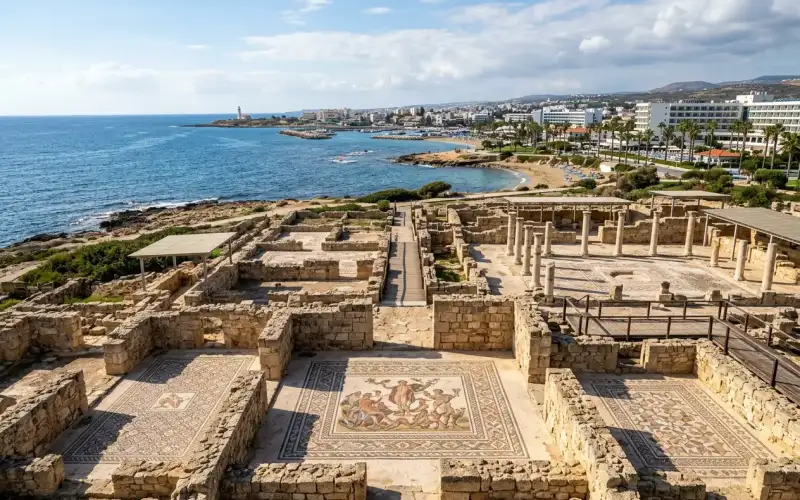
I was standing in the House of Dionysus on a March morning in 2024 when a British couple in their sixties asked me why the mosaics were so badly damaged. The wife pointed at the worn stone floor and said, "If these are supposed to be treasures, shouldn't they be indoors?" She had a point. What struck me then—and what I've come back to repeatedly over twenty years of visiting Paphos—is that most tourists see the villas as open-air museums of pretty pictures. They miss the real story: these weren't art galleries. They were homes. Brutally practical, status-conscious, and surprisingly comfortable ones.
The Roman villas scattered across Paphos tell the story of wealth, power, and daily life in one of the empire's most prosperous provinces. Between the 2nd and 4th centuries AD, Cyprus wasn't a backwater—it was a crucial trade hub, and Paphos was its crown jewel. The villas you can visit today aren't ruins in the romantic sense. They're archaeological sites that demand time, context, and a willingness to imagine what happened in those rooms nearly two thousand years ago.
What Makes Paphos's Roman Villas Different from Other Mediterranean Sites?
Most visitors compare Paphos's villas to Pompeii or Herculaneum. That's a mistake. Pompeii was frozen in volcanic ash in 79 AD. The villas of Paphos were gradually abandoned and buried by earthquakes, sand, and neglect over centuries. Nothing here was preserved in a single catastrophic moment. What you're looking at is a palimpsest—layers of occupation, destruction, rebuilding, and eventual desertion.
The House of Dionysus, the flagship site, covers roughly 10,000 square metres. It wasn't built all at once. The oldest sections date to around 120 AD, but the villa was expanded, modified, and redecorated multiple times over three centuries. By the time it was finally abandoned in the early 4th century—possibly due to earthquake damage or economic decline—it had been reconstructed so many times that archaeologists can literally read its biography in the stone.
What's unique to Paphos specifically is the quality of the mosaic work. The artisans here weren't copying Greek or Italian patterns. They developed their own regional style, blending Hellenistic traditions with Roman imperial taste. The mosaics you see—Dionysus himself, the hunting scenes, the geometric borders—were created by craftsmen who understood their local market and what wealthy Cypriot landowners wanted to display.
Where Exactly Is the House of Dionysus, and What Will You Actually See?
The House of Dionysus sits in Kato Paphos, roughly 2 kilometres south of the modern town centre, near the seafront. If you're driving, follow signs for the archaeological site. There's a small car park, and the entrance fee in 2026 is €9 for adults, €4.50 for seniors, free for children under 6. Opening hours are 8:30 AM to 5:00 PM daily, though hours shorten to 4:00 PM in winter (November to March).
When you enter, you're walking through what was once the atrium—the central reception area. The floor here is largely reconstructed modern concrete, which is honest if unglamorous. But beyond that, you'll see the peristyle, the columned courtyard that would have been the heart of the house. Fragments of the original columns still stand. Imagine servants moving through here, water trickling in the central pool, and the owner receiving guests in the surrounding rooms.
The mosaics are concentrated in the triclinium (dining room) and several cubicula (bedrooms). The most famous is the Dionysus mosaic itself—the god riding a leopard, surrounded by attendants and creatures. It's roughly 5 metres across and dates to around 200 AD. The tesserae (tiny stone tiles) are mostly limestone and marble, with some imported lapis lazuli for the deep blues. The work is meticulous but not flawless. You can see where repairs were made, where tiles have shifted slightly over centuries.
One thing that surprises visitors: there are no protective barriers. You walk right up to the mosaics. This means they're deteriorating faster than archaeologists would like, but it also means you can see the detail without glass or distance. It's a trade-off between preservation and access that the Cypriot authorities have made deliberately. You'll also notice that some mosaics are covered with sand and gravel for protection during the winter months.
What Other Roman Villas Can You Visit Near Paphos?
The House of Dionysus dominates visitor attention, but it's not the only villa worth seeing. The House of Aion, also in Kato Paphos about 500 metres away, is smaller but in some ways more intimate. It dates to the 5th century AD—later than the Dionysus house—and was likely destroyed in an earthquake around 550 AD. What remains includes a remarkable mosaic of Aion (the personification of eternity) surrounded by the seasons. The artistic style here is noticeably different from the earlier villa: more abstract, less naturalistic, reflecting changing tastes and perhaps a different workshop.
The House of the Four Seasons, near the House of Aion, is less frequently visited but offers clearer remains of the actual architecture. You can trace the room layouts more easily here because the walls survived better. It's a good place to understand how these houses actually functioned as domestic spaces, not just art repositories.
If you're willing to venture outside Paphos proper, the villa at Kouklia (about 15 kilometres inland) is worth a half-day trip. It's older—occupation dates back to the Mycenaean period—and the Roman villa sections are less impressive than the Paphos sites. But the museum on the grounds contains finds from the entire region, and the landscape context helps you understand why Romans chose these particular locations. Kouklia was on a major trade route, with access to agricultural land and fresh water.
Why Were These Villas Built Where They Were?
This is where archaeology becomes geography. The villas of Paphos weren't built randomly. They cluster in the coastal plains and lower hills, close to the sea but not directly on the beach. The House of Dionysus is about 500 metres inland—far enough to avoid the worst of the salt spray and storm surge, close enough to maintain contact with the port.
Paphos was the Roman administrative capital of Cyprus and a major exporter of wine, oil, and grain. The wealthy families who built these villas were either landowners with estates in the interior or merchants with interests in the port. The villas themselves often had agricultural components—storage areas for oil and wine, sometimes evidence of pressing facilities. The mosaic of Dionysus, god of wine, wasn't just decorative. It was a statement about the owner's wealth and business interests.
Water access was crucial. The House of Dionysus had a sophisticated system of cisterns and channels to collect and distribute water. In a Mediterranean climate, controlling water meant controlling wealth. The location, the size, the decorative programme—all of it was calculated.
What Was Daily Life Actually Like Inside These Villas?
Here's where imagination matters. The mosaics show us what the owners wanted to project: sophistication, cultural refinement, connection to the wider Greco-Roman world. But the archaeology also reveals practical details. The triclinium (dining room) had a specific layout: the diners reclined on three couches arranged in a U-shape, with servants moving in and out. The kitchen was separate, usually in a less decorated part of the house. The cubicula (bedrooms) were small, dark, and often had no decoration at all.
Servants and slaves did most of the work. Archaeological evidence—pottery, grinding stones, hearths—suggests that the House of Dionysus had a substantial staff. The family itself probably occupied only a fraction of the space. The rest was for storage, work, and the accommodation of enslaved people and hired workers.
Meals were elaborate for the wealthy. The House of Aion contains a mosaic showing a banquet scene. Wine came from local vineyards, fish from the sea, and exotic spices from the East. The Romans in Paphos ate well. Archaeological analysis of bones and seeds found in the villas shows a diet heavy in fish, grain, and wine, with seasonal vegetables and occasional meat.
How Do Archaeologists Know What They Know About These Sites?
Excavation of the House of Dionysus began in 1962 and continued through the 1970s. The work was meticulous but by modern standards, incomplete. Earlier excavations didn't record stratigraphic detail the way contemporary archaeology demands. But the site has been revisited repeatedly, and new techniques—ground-penetrating radar, for instance—have revealed structures that weren't obvious to earlier diggers.
The dating of the mosaics comes from several sources. Stylistic analysis compares them to dated mosaics from elsewhere in the Roman world. Coins found in the rubble provide terminus ante quem (earliest possible date) evidence. Pottery styles help establish chronology. And occasionally, inscriptions—names or dedications—appear in the mosaics themselves, though they're rare in Paphos.
One significant discovery came in the 1990s when archaeologists realised that the House of Dionysus wasn't a single villa but a complex of buildings. What looked like a single structure was actually multiple properties that had been joined together over time. This changed how experts understood the site's history and the economic status of its owners.
What's the Best Way to Visit These Sites in 2026?
First, go early. By 10:00 AM in summer, the House of Dionysus is crowded with tour groups. If you arrive at 8:45 AM, you'll have the mosaics largely to yourself for thirty minutes. The light is also better in early morning—the sun angles across the floors and brings out details that disappear in harsh midday glare.
Second, hire a guide or buy a detailed guidebook beforehand. The site itself has minimal signage. Without context, you're looking at pretty pictures and ruins. With context, you're reading a story. The Paphos Archaeological Museum, about 2 kilometres away, has excellent displays and a bookshop with specialist publications. Spending an hour there first makes the villa visit far more meaningful.
Third, bring water and sun protection. There's minimal shade at the sites. In summer, the ground itself radiates heat. Comfortable walking shoes are essential—the paths are uneven, and you'll be on your feet for at least two hours if you're doing both the House of Dionysus and the House of Aion properly.
Fourth, plan for about three hours total: forty-five minutes to an hour at the House of Dionysus, thirty minutes at the House of Aion, and time for the museum. If you're particularly interested in Roman archaeology, allow a full day and include Kouklia as well.
What Happened to These Villas? Why Were They Abandoned?
The House of Dionysus was destroyed in an earthquake, probably in the early 4th century AD. The damage was severe enough that rebuilding wasn't attempted—or perhaps the economic situation in Cyprus had deteriorated enough that it wasn't worth the investment. By the 5th century, the villa was already a ruin, gradually being buried by sand and soil.
Earthquakes were common in Cyprus. The island sits on a tectonically active zone. The major quake that destroyed Salamis and Paphos in 332 AD was catastrophic. But there were others. The House of Aion shows evidence of multiple earthquake cycles—destruction, repair, destruction again. Eventually, the cycle stopped. People moved away, the site was abandoned, and the Mediterranean climate did the rest. Wind, rain, and sand gradually covered everything.
By the medieval period, the villas were completely forgotten. They weren't rediscovered until the 19th century, when European travellers began exploring Cyprus and noting the mosaics. Systematic excavation didn't begin until the 20th century.
Are These Sites Worth the Visit, Honestly?
Yes. But with caveats. If you're expecting Pompeii-style preservation, you'll be disappointed. If you're willing to use your imagination and spend time understanding the context, you'll find them genuinely moving. Standing in the triclinium of the House of Dionysus, looking at a mosaic that a craftsman created nearly two thousand years ago, connects you to something real. Not a fantasy, not a reconstruction—actual evidence of actual people.
The mosaics are beautiful, but they're beautiful because they're fragments. They're damaged, incomplete, and all the more human for it. That's what makes Paphos's Roman villas special. They're not perfect museum pieces. They're archaeology—messy, complex, and endlessly interesting.
Comments (3 comments)