

Last May, I watched a couple from Surrey spend forty minutes trying to find a parking space at Coral Bay on a Tuesday afternoon. They'd expected a quiet morning swim. Instead, they found three hundred sunbeds arranged in military rows, a queue at the taverna, and a beach that felt less like a secret and more like a theme park with salt water. By lunchtime, they'd driven north to Lara Beach, found one other family, and spent the afternoon watching loggerhead turtles surface offshore. Both had their point. Neither couple was wrong.
This is the eternal Paphos beach dilemma: convenience or authenticity. Coral Bay and Lara Beach sit roughly twenty kilometres apart on the north coast, and they represent two entirely different philosophies about what a Mediterranean holiday should feel like. After twelve years living here, I've walked both dozens of times—in high season, low season, and everything between. I've also listened to hundreds of British visitors wrestle with the choice. So let's settle this properly.
Coral Bay: The Managed Experience
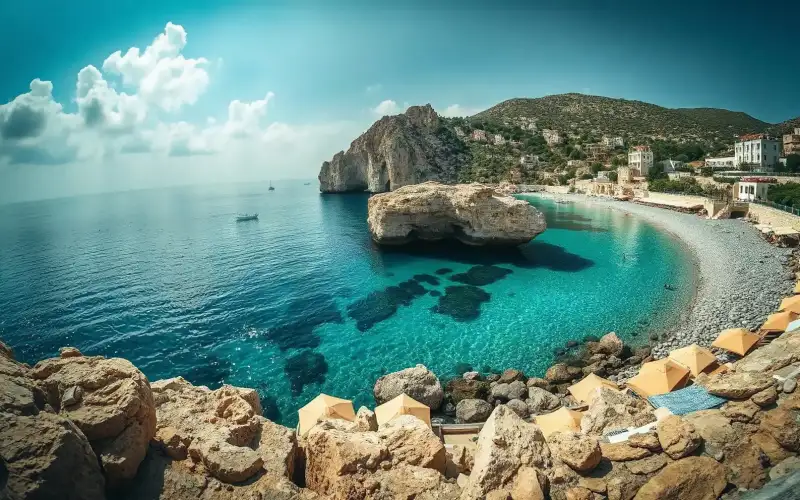
Coral Bay lies about fifteen kilometres northeast of Paphos town, accessible by a decent coastal road that takes roughly twenty-five minutes by car from the harbour. There's a large car park—€2 per day in summer, free in winter—and you'll find it full by 10 a.m. on any day between June and September. The beach itself is perhaps two hundred metres of sand, backed by limestone cliffs that glow apricot in the afternoon light.
The facilities here are, frankly, what you'd expect from a resort beach anywhere in the Mediterranean. Three tavernas operate along the shoreline, all charging similar prices: €12–14 for a grilled fish plate, €8 for a Greek salad, €3 for a coffee. Sunbed hire runs €5 per bed or €8 for a bed-and-umbrella combo. There's a water sports operator offering jet skis (€60 for fifteen minutes), banana boats, and paddleboards. A small shop sells ice cream, inflatables, and sun cream at roughly double the price you'd pay in town.
What makes Coral Bay genuinely useful is the consistency. If you're travelling with elderly parents or young children, you know exactly what you're getting. The water is clean, the slope is gentle, and lifeguards are on duty during summer months. The tavernas are reliable—I've never had a bad meal at any of them, though neither have I had a transcendent one. It's competent, professional, and utterly predictable.
The crowd is the real story, though. On a July afternoon, Coral Bay hosts perhaps five hundred people. Families cluster in the shallows. Couples occupy premium sunbed spots near the water. Older visitors sit under umbrellas reading novels. It's a cross-section of northern Europe—German, Dutch, British, Scandinavian—all speaking their own languages and mostly ignoring each other in that polite way tourists do.
The access is straightforward. The road is well-maintained. Mobile signal is strong. You can walk from the car park to the water in three minutes. For visitors with mobility issues or those who simply prefer not to trek, this matters enormously.
Lara Beach: The Untamed Alternative
Lara lies roughly forty kilometres north of Paphos town, at the end of a narrowing road that climbs through pine forest and past scattered villages. The final approach is unpaved for the last two kilometres—not treacherous, but enough to make you notice you're leaving the tourist infrastructure behind. There's a small car park, usually empty even in peak season, and the beach stretches for nearly a kilometre in both directions.
The contrast with Coral Bay is immediate and deliberate. There are no sunbeds, no tavernas, no water sports operators, and no lifeguards. What you'll find instead is sand, sea, cliffs, and often the company of very few other people. I've been there in August and counted perhaps thirty visitors across the entire beach. On a May afternoon, I've been entirely alone.
Lara's real claim to fame, though, is the turtles. Between May and August, loggerhead turtles nest on this beach—sometimes dozens of them in a single season. If you're here in early morning or late evening during nesting season, you might witness a female hauling herself out of the water to dig a nest in the sand. It's genuinely extraordinary. I've lived here over a decade and still feel a small thrill seeing the tracks.
The beach itself is wilder than Coral Bay. The sand is coarser in places. The water is equally clean but slightly colder due to the northern exposure. The cliffs are higher and more dramatic. There's a sense of being somewhere that hasn't been entirely packaged for consumption.
The trade-offs are real, though. You'll need to bring your own water and food—there's nothing to buy. You'll need to use the facilities before you arrive, as there are no toilets. The road condition means you really need a car; buses don't run here. Mobility access is poor; the walk from the car park to the water is perhaps five minutes, but it's uneven and sandy.
Access and Practical Considerations
This is where the comparison becomes concrete and worth thinking through carefully.
Getting there: Coral Bay is twenty-five minutes by car from Paphos town centre. The road is excellent. Public buses serve it—the 631 runs from Paphos town roughly hourly in summer. Lara requires a car and thirty-five to forty minutes' drive, with the final stretch on an unpaved road that's fine in dry weather but requires care.
Parking: Coral Bay has a dedicated car park with capacity for perhaps three hundred vehicles. In peak season, it fills by mid-morning. Lara has a small informal car park with space for maybe fifty vehicles, rarely full.
Facilities: Coral Bay offers tavernas, toilets, showers, water sports, and a small shop. Lara offers none of these. You must bring everything you need.
Accessibility: Coral Bay is suitable for visitors with mobility issues. The walk is short and level. Lara is not; the walk is longer and the terrain is uneven sand.
Here's a practical table for the key metrics:
| Factor | Coral Bay | Lara Beach |
|---|---|---|
| Distance from Paphos town | 15 km (25 mins) | 40 km (35–40 mins) |
| Road condition | Excellent asphalt | Asphalt + 2 km unpaved |
| Public transport | Bus 631, hourly in summer | None |
| Car park capacity | ~300 spaces | ~50 spaces |
| Parking cost | €2/day (summer), free (winter) | Free |
| Tavernas | 3 operating | None |
| Sunbed hire | €5–8 per bed | Not available |
| Toilets and showers | Yes | No |
| Lifeguards (summer) | Yes | No |
| Peak season crowd | 300–500 people | 20–50 people |
| Turtle nesting season | Rare | May–August, common |
The Turtle Question: Why Lara Matters
If you're visiting between May and August, the loggerhead turtle nesting is genuinely worth understanding. Cyprus hosts one of the Mediterranean's most important loggerhead populations. Lara Beach is a designated protected area, part of the Akamas Peninsula's conservation efforts.
The turtles arrive at night, typically between 9 p.m. and 4 a.m. A female will swim ashore, dig a pit in the sand, deposit roughly one hundred eggs, and return to sea—the whole process takes about an hour. The eggs incubate for roughly two months. In August and early September, hatchlings emerge and make their way to the water, a journey of perhaps fifty metres that's genuinely perilous; predators, dehydration, and disorientation all pose risks.
If you're there in early morning during nesting season, you might see the tracks—deep grooves in the sand where a turtle has hauled herself out. It's a moment that connects you to something ancient and fragile. I've brought visitors here specifically for this, and I've never had anyone regret the early start.
Coral Bay, by contrast, is too developed and too busy for turtles. The lights, the noise, and the sheer human presence make it unsuitable for nesting. You won't see turtles there, and that's precisely why the beach works so well for families who want facilities and activity.
Which Beach Suits You?
This isn't actually a close call once you know what you want. The choice depends almost entirely on what you value in a beach day.
Choose Coral Bay if: You're travelling with children under twelve or elderly relatives with mobility concerns. You want reliable facilities—toilets, food, somewhere to rent a sunbed if you've forgotten yours. You're visiting in July or August and want to know you'll find a spot without arriving at dawn. You prefer social activity and don't mind crowds. You're on a tight schedule and want to minimize travel time from Paphos town.
Choose Lara Beach if: You're visiting in May, June, or September and want to see turtles. You prefer solitude and don't mind bringing your own supplies. You have a car and don't mind an unpaved road. You're interested in Cyprus's natural heritage and want to support conservation by visiting a protected area. You're willing to plan ahead and arrive with food, water, and sunscreen already in hand.
Honestly, many British visitors do both. A couple spending two weeks might do Coral Bay twice for the ease of it, and Lara once for the experience. That's perfectly reasonable.
Seasonal Timing Matters
When you visit changes everything. July and August at Coral Bay are genuinely crowded—I'd estimate five hundred people on a typical afternoon. May and June are much quieter, perhaps two hundred. September and October see the crowds thin considerably, and the water is still warm.
Lara is quieter year-round, but it's most interesting during turtle nesting season (May through August). An October visit to Lara is perfectly pleasant but lacks the wildlife interest that makes it special.
If you're flexible on timing, I'd suggest May or early June. The weather is warm, the water is swimmable, the turtle activity is high, and the crowds at Coral Bay are manageable. September is also excellent—warm, quieter, and still within turtle season for early hatchlings.
Honest Pros and Cons Summary
Coral Bay Pros: Reliable facilities, easy access, suitable for all ages and mobilities, good tavernas, water sports available, lifeguards in summer, public transport option, predictable experience.
Coral Bay Cons: Crowded in peak season, expensive for what you get, no wildlife interest, feels commercialized, parking fills early, no turtles, sunbeds and umbrellas create a cluttered feel.
Lara Beach Pros: Genuinely wild and beautiful, turtle nesting season is extraordinary, solitude and space, free parking, protected area with conservation value, dramatic scenery, feels authentic.
Lara Beach Cons: No facilities whatsoever, requires advance planning and supplies, unpaved road access, no public transport, poor accessibility for mobility issues, longer drive, no food or water available on-site, must bring everything.
Final Thoughts: Both Have Their Place
After twelve years here, I don't think this is actually a competition. Coral Bay and Lara Beach serve different purposes for different visitors. Coral Bay is what you want when you're tired, your relatives are visiting, or you simply want a straightforward beach day with reliable facilities. Lara is what you want when you're curious about Cyprus's natural heritage, willing to plan ahead, and seeking something that feels less packaged.
The best visitors I know do both. They understand that a holiday isn't about finding the one perfect beach—it's about matching your mood and energy to what's available. Some days you want taverna food and sunbeds. Some days you want sand, solitude, and the possibility of seeing something genuinely wild.
If you're planning a 2026 trip to Paphos and have time for two beaches, do exactly that. Spend one afternoon at Coral Bay, enjoy the facilities, and don't apologize for the crowds. Spend another morning at Lara, bring a picnic, and if you're there during turtle season, set your alarm for 6 a.m. Both experiences are worth having. Both tell you something true about Cyprus.
Comments (0 comments)
No comments yet — be the first!