
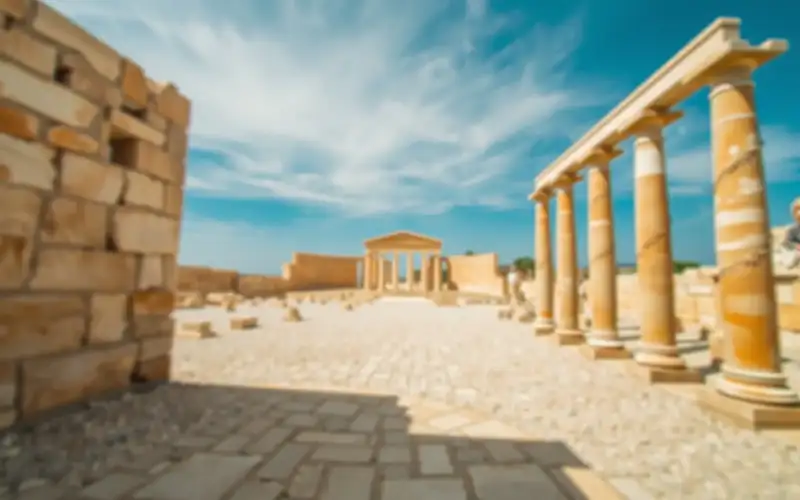
On my first proper morning in Paphos — this was back in 2014, not long after I had moved here from Bath — I walked into the Archaeological Park expecting a pleasant stroll among a few old stones. Three hours later I was still there, crouched beside a third-century mosaic of Dionysus accepting a cup of wine, completely oblivious to the tour group politely trying to step around me. That is the effect this place has on people who care about the ancient world. It does not announce itself with the grandeur of the Acropolis or the sheer scale of Pompeii, but what it offers — intimate, extraordinarily well-preserved Roman floor mosaics sitting open to the Mediterranean sky — is, in my view, unmatched anywhere in the eastern Mediterranean.
The Paphos Archaeological Park covers roughly 1.6 square kilometres of Kato Paphos, the lower, coastal district of the city. It was inscribed on the UNESCO World Heritage List in 1980, recognised as an exceptional testimony to Hellenistic and Roman civilisation on Cyprus. Excavations, led principally by Polish and Cypriot archaeologists since the 1960s, are ongoing; new discoveries still surface every few seasons. This handbook will tell you exactly what to see, in what order, at what cost, and how to avoid the most common mistakes first-time visitors make.
What You Will Learn (and What to Expect)
This guide is structured as a step-by-step walkthrough of the park. By the end you will know: how to buy tickets and what they cost in 2026; which mosaic houses to prioritise if time is short; a logical two-hour route that minimises backtracking; the accessibility situation (it is complicated); and a few practical tips that most guidebooks omit. I have walked this site dozens of times and have led informal tours for friends and neighbours, so the advice here is grounded in direct experience rather than copied from a leaflet.
The park is not a theme attraction. There are no audio-visual centres, no reconstructed Roman dining rooms, no actors in togas. What there is, instead, is the real thing: mosaic floors laid by Roman craftsmen around the second to fourth centuries AD, a Hellenistic odeon rebuilt by the Romans, a lighthouse, a medieval castle, and the exposed foundations of a Hellenistic agora. Come prepared to use your imagination, and bring the curiosity you would bring to any serious historical site.
Before You Go: Prerequisites and Practical Essentials
A handful of preparations will make the difference between a frustrating visit and a genuinely memorable one.
Tickets and Opening Hours
In 2026 the standard adult admission is €8.50. Concessions (students with valid ID, over-65s) are €4.25. Children under 12 enter free. A combined ticket covering the Archaeological Park and the Paphos District Archaeological Museum on Grivas Digenis Avenue costs €12.50 for adults and represents good value if you intend to visit both — the museum holds finds from the park that cannot be displayed on site.
| Season | Opening Hours |
|---|---|
| 1 April – 31 October | 08:00 – 19:30 (last entry 19:00) |
| 1 November – 31 March | 08:00 – 17:00 (last entry 16:30) |
| Public holidays | 09:00 – 15:00 (check locally) |
Tickets are sold at the main entrance kiosk on Apostolou Pavlou Avenue, roughly 300 metres south-west of the Paphos harbour roundabout. You can also pay by card. There is no advance online booking system for individual visitors; simply turn up. Groups of ten or more should contact the Department of Antiquities in advance.
What to Wear and Bring
- Footwear: The paths between mosaic houses are uneven compacted gravel and ancient stone. Flat, closed-toe shoes are strongly recommended. Sandals with ankle support are acceptable; flip-flops are not.
- Sun protection: Between May and October, the site offers almost no shade outside the covered mosaic shelters. A hat and sunscreen are not optional.
- Water: There is one small café near the Odeon, but it is not always open. Carry at least 500ml per person.
- A printed or downloaded map: The site map given with your ticket is small and not always easy to read in bright sunlight. Download a higher-resolution version from the Department of Antiquities website before you arrive.
- Binoculars (optional but worthwhile): Some mosaic details — particularly the border inscriptions in the House of Aion — are easier to read from a slight distance.
Getting There
The park entrance is a 12-minute walk from the harbour along Apostolou Pavlou Avenue, passing the Paphos Medieval Castle. Taxis from the town centre cost around €5–7. The 615 bus from Karavella bus station stops on Apostolou Pavlou Avenue approximately every 40 minutes on weekdays; less frequently at weekends. Parking is available in the small car park adjacent to the entrance and along the road, though spaces fill by mid-morning in July and August.
Step-by-Step: The Recommended Two-Hour Route
The following route is designed for a visitor with roughly two hours available. It covers the principal highlights without excessive backtracking. If you have three hours, I will note where to linger.
Step 1 — Enter and Orient Yourself (10 minutes)
Collect your ticket and the site map. Stand at the entrance and look south-east: the large modern shelter roofs directly ahead of you cover the House of Dionysus. To your left, further along the coastal path, is the Odeon and the Saranta Kolones castle ruins. To your right, partially excavated, lie the remains of the Roman agora. Spend two minutes with the map before moving. The park's internal paths are not always intuitively signposted, and it is surprisingly easy to miss the House of Aion, which sits slightly off the main tourist trail.
Step 2 — The House of Dionysus (35 minutes)
This is the centrepiece of the entire park and deserves the largest portion of your time. The house was a wealthy Roman private residence, probably dating to the late second century AD, and its floors contain fourteen distinct mosaic panels covering approximately 2,000 square metres in total. The protective shelter above was erected in the 1970s and, while architecturally unremarkable, has done its job: the colours remain vivid.
Move through the house in the order indicated by the arrows on the floor. The first panel you encounter is the Narcissus mosaic — small, slightly damaged, but with a melancholy elegance that sets the tone. Then comes the celebrated Triumph of Dionysus: the god rides a chariot drawn by two leopards, surrounded by his thiasos (retinue) of satyrs and maenads. The craftsmanship here, particularly in the rendering of the leopards' spotted coats, is extraordinary. Allow yourself to stop and look properly rather than shuffling past.
Further into the house, the Pyramus and Thisbe panel illustrates the tragic Ovidian myth that later inspired Shakespeare's Romeo and Juliet — a detail that never fails to delight visitors who make the connection. The Four Seasons mosaic, a large geometric composition framing allegorical female figures, occupies the floor of what was probably the main reception room (triclinium). If you have children with you, ask them to identify which season is which; the attributes — a sickle for summer, bare branches for winter — are clear enough to read across two thousand years.
The Roman craftsmen who laid these floors were not local amateurs. The stylistic parallels with mosaics found at Antioch and Alexandria suggest that the workshops operating in second-century Paphos were part of a wider eastern Mediterranean tradition of highly mobile, highly skilled artisans working to commission for the provincial elite.
Step 3 — The House of Theseus (15 minutes)
A short path leads south-west to the House of Theseus, identified by excavators as the residence of the Roman proconsul of Cyprus — in other words, the governor's palace. It is the largest private Roman building yet discovered on the island, covering some 9,600 square metres across multiple building phases from the second to the fifth century AD.
The mosaic you have come to see is the Birth of Achilles, dating to the fourth century AD and considered one of the finest late-Roman mosaics in Cyprus. Achilles lies at the centre, a newborn being washed by the Nereids while the Fates look on. The composition has a stillness — almost a tenderness — unusual in Roman mosaic art, which tends toward the triumphant and the violent. Directly adjacent is the Theseus and the Minotaur panel, which gives the house its name: Theseus stands over the defeated creature in a circular composition framed by a personification of Crete and the labyrinth itself.
Step 4 — The House of Aion (15 minutes)
This is the mosaic that specialists get most excited about, and the one most general visitors walk past too quickly. The House of Aion contains a single large mosaic divided into five registers, dating to around the mid-fourth century AD. It is a complex, densely iconographic work that appears to be a deliberate response to the rise of Christianity: the imagery — the beauty contest of Cassiopeia, the triumph of Dionysus, the infant Dionysus presented to the god of time — reads as a sophisticated pagan argument for the continuing relevance of the old religion at a moment when it was losing ground to the new.
The house is slightly set back from the main path; look for the smaller shelter roof to the north-east of the House of Theseus. Give yourself ten minutes here even if the iconography does not immediately speak to you. The border inscriptions, in Greek, are among the few mosaic texts preserved in the park.
Step 5 — The House of Orpheus (10 minutes)
A brief detour north brings you to the House of Orpheus, smaller than the other houses and sometimes skipped by visitors running short of time. Do not skip it. The central mosaic shows Orpheus seated with his lyre, surrounded by an audience of animals — lion, bear, deer, hare, peacock — each rendered with individual character. There is a quality of quiet enchantment here that I find more affecting than the grander mythological scenes elsewhere in the park.
Step 6 — The Odeon and the Lighthouse (15 minutes)
Walk north-west along the coastal path toward the small hill known as Fabrika. The Odeon is a semi-circular Hellenistic theatre, originally built in the second century BC and substantially rebuilt by the Romans. It seats approximately 1,200 people and is still used for performances during the Paphos Aphrodite Festival in September. The seating tiers are original limestone; walking up them gives you a fine view across the site toward the sea. Adjacent to the Odeon stands a Roman lighthouse — or rather, its lower courses, which survive to about four metres. It is easy to miss but worth a moment's attention as one of only a handful of Roman lighthouse remains in the eastern Mediterranean.
Step 7 — Saranta Kolones Castle (20 minutes)
The final stop on the route, and the most dramatically different in character, is Saranta Kolones — the Castle of the Forty Columns. The name refers to the granite columns scattered across the site, originally Roman, later incorporated into the Byzantine and then Lusignan fortification. The castle was built by the Byzantines in the seventh century AD as a defence against Arab raids, substantially expanded by the Crusader Lusignan dynasty after 1191, and then comprehensively destroyed by the earthquake of 1222. It has never been rebuilt, which gives it a raw, romantic quality quite different from the manicured mosaic houses.
Scramble (carefully) up the central keep for a panoramic view of the whole Archaeological Park, the harbour, and on a clear day, the outline of the Akamas peninsula to the north. Children who have been patient through the mosaic houses tend to find Saranta Kolones a rewarding finale.
Accessibility: An Honest Assessment
The Paphos Archaeological Park has made efforts to improve accessibility, but it remains a challenging site for visitors with limited mobility. The paths between houses are gravel and uneven. The House of Dionysus has a ramped entrance and most of the mosaic viewing walkways are accessible by wheelchair, though some sections are narrow. The House of Theseus and House of Aion have level access to the main viewing areas. Saranta Kolones is not accessible by wheelchair; the ground is very rough and there are no formal paths within the castle ruins.
Visitors with mobility concerns should contact the Department of Antiquities (telephone: +357 26 306 217) before their visit to discuss current conditions. The site does not provide wheelchairs for loan.
Troubleshooting: Common Problems and How to Avoid Them
The site feels overwhelming and I do not know what I am looking at
The information panels within the mosaic houses are reasonably detailed but assume some familiarity with Greco-Roman mythology. If you are not confident identifying Dionysus from Apollo or knowing your Minotaur from your Medusa, spend twenty minutes the evening before your visit reading a brief summary of the relevant myths. The BBC's online mythology resources or a simple Penguin Classics edition of Ovid's Metamorphoses will serve you well. Alternatively, licensed guides can be hired at the entrance for approximately €35 for a two-hour tour; this is genuinely worth the cost for first-time visitors.
It is extremely hot and I am running out of energy
Visit in the morning. The site opens at 08:00 and the first two hours — between 08:00 and 10:00 — are cooler, less crowded, and the light on the mosaics is softer and more flattering for photography. Between June and August, a midday visit is genuinely unpleasant and potentially dangerous for older visitors or young children.
The café is closed and I have run out of water
The harbour promenade, a ten-minute walk from the main entrance, has numerous cafés and restaurants open from early morning. Alternatively, the small supermarket on Apostolou Pavlou Avenue (about 200 metres north of the entrance) sells cold water and snacks.
I only have one hour — what do I prioritise?
In one hour: the House of Dionysus (25 minutes), the House of Theseus focusing on the Birth of Achilles panel (15 minutes), and a brief walk around Saranta Kolones (20 minutes). You will miss the Houses of Aion and Orpheus, which is a genuine loss, but you will leave with a coherent impression of the site's range and quality.
Guided tours from the harbour — are they worth it?
Several operators on the harbour offer combined Kato Paphos walking tours that include the Archaeological Park. These typically last three to four hours, include entrance fees, and cost around €25–30 per adult. They are good value for first-time visitors who want context, but the group sizes can be large (up to 20 people) and the pace is sometimes rushed through the lesser-known houses. If the House of Aion matters to you, a self-guided visit gives you more control.
A Final Word on Why This Place Matters
Paphos was the capital of Roman Cyprus from roughly 58 BC until the Arab raids of the seventh century AD — a period of nearly seven hundred years during which it was one of the most prosperous and cosmopolitan cities in the eastern Mediterranean. The mosaics in the Archaeological Park are not decorative curiosities. They are the material record of a literate, wealthy, mythologically sophisticated society that used art to signal status, learning, and religious identity. When you stand in the House of Aion and look at a pagan mosaic commissioned, probably, within a generation of the Emperor Constantine's conversion to Christianity, you are looking at an act of cultural resistance — a wealthy Paphian saying, in tesserae and mortar, that the old stories still matter.
Archaeology at its best is not about objects. It is about the people who made them, and what they were trying to say. Paphos Archaeological Park, more than almost any site I know in the Mediterranean, lets you hear those voices clearly.
The park repays repeat visits. I have been here more times than I can count and I still find new details — a border inscription I had not noticed, a repair in the mosaic where an ancient craftsman patched a damaged section with slightly different tesserae, a shadow falling across the Triumph of Dionysus at four in the afternoon that makes the leopards look as though they are moving. Go once, go properly, and you will almost certainly go again.
Comments (2 comments)